

THE SOCIO-AESTHETIC MANIFESTO
A structure that demands nothing. It stands as a silent defiance against the total commodification of existence. Its cost is zero. Its utility is survival.
The city’s noise becomes its natural soundtrack.
This is the final frontier of privacy. A territory where nothing owns you. In a world oversaturated with objects, Bannana House returns to the triad: Cardboard. Form. Body.
Fragility becomes the only inalienable property of a human being. The project does not hide vulnerability — it sanctifies it.
The city’s noise becomes its natural soundtrack.
This is the final frontier of privacy. A territory where nothing owns you. In a world oversaturated with objects, Bannana House returns to the triad: Cardboard. Form. Body.
Fragility becomes the only inalienable property of a human being. The project does not hide vulnerability — it sanctifies it.
Bannana House is not "housing". It is critical architecture, a philosophical installation, and a social gesture. What remains of a person when all social garments are stripped away?
The Body. The Fragility. The Right to Shelter.
In an era of total commodification, Bannana House reminds us: a person's final home is not measured in square meters, but in the capacity to sustain life within the tightest constraints. The art of survival becomes the Art itself.
The Body. The Fragility. The Right to Shelter.
In an era of total commodification, Bannana House reminds us: a person's final home is not measured in square meters, but in the capacity to sustain life within the tightest constraints. The art of survival becomes the Art itself.
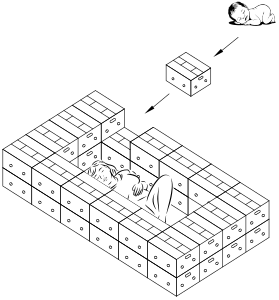
No walls. No ownership.
Only cardboard, form, and the body.
Only cardboard, form, and the body.
A shelter for Bare Life.
Bannana House is not a humanitarian project.
It is a critical architectural utopia — an editioned prototype of minimum human shelter.
It is not meant to be lived in.
It is meant to be understood.
It exposes the logic that packs human life into standard sizes and marks it “Fragile.”
Bannana House begins where the illusion of permanent housing ends.
Inspired by the philosophy of Giorgio Agamben, it is a minimal vessel for the body reduced to its biological core.
A container in which power agrees to tolerate our existence. Architecture for homo sacer.
Bannana House is not a humanitarian project.
It is a critical architectural utopia — an editioned prototype of minimum human shelter.
It is not meant to be lived in.
It is meant to be understood.
It exposes the logic that packs human life into standard sizes and marks it “Fragile.”
Bannana House begins where the illusion of permanent housing ends.
Inspired by the philosophy of Giorgio Agamben, it is a minimal vessel for the body reduced to its biological core.
A container in which power agrees to tolerate our existence. Architecture for homo sacer.
EDITIONED UTOPIA
Ten dimensions — from the length of a newborn to the stature of an elder.
Life is packed into standard industrial scales, treated as fragile cargo.
Each module is assembled from two rows of empty banana boxes — the same crates that travel the world unnoticed, now building a shelter.
They are covered with the "Banana Blanket": flat cardboard sheets that serve as a roof, a shield, and the primary layer between the body and the earth.
The boxes bear the "Fragile" mark. A silent reminder: the most vulnerable element in this world is human life.
Models 001−010: From infancy to old age.
Life is packed into standard industrial scales, treated as fragile cargo.
Each module is assembled from two rows of empty banana boxes — the same crates that travel the world unnoticed, now building a shelter.
They are covered with the "Banana Blanket": flat cardboard sheets that serve as a roof, a shield, and the primary layer between the body and the earth.
The boxes bear the "Fragile" mark. A silent reminder: the most vulnerable element in this world is human life.
Models 001−010: From infancy to old age.

